There was a time when the Venetian lagoon was nothing but mud, reeds, and tides.
A place of refuge rather than ambition. And yet, right there, rose Venice — an impossible city, built not against the water but together with it.
👉 Watch our full documentary on Venice
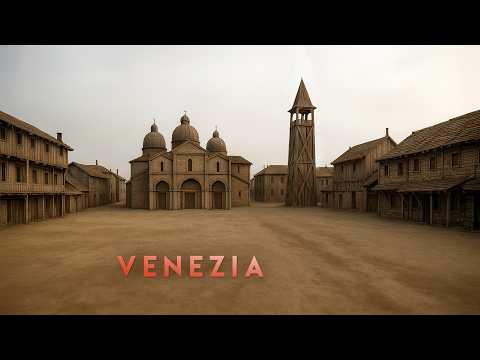
In the 5th century, as the Western Roman Empire collapsed and barbarian invasions swept Italy, people fled inland cities like Padua and sought refuge on the islands of the lagoon.
At first, there were only huts on stilts, makeshift shelters in the marshes. But the lagoon was a liquid labyrinth, impossible for invaders to penetrate. What began as temporary refuge became a community, a village, and finally a city.
The question everyone asks: How can you build a city on water?
The answer lies underground, in the foundations.
Thus, Venice rose on a forest of submerged wood, still holding the city today.
Venetian houses were narrow and tall, to maximize limited space.
Lower floors, vulnerable to tides, served as warehouses and workshops, while families lived upstairs. Facades opened onto the canals, with arched windows, iron balconies, and sober elegance.
At first, people crossed by boat, even for a few meters. The earliest bridges were wooden and movable.
The most famous, the Rialto, began as a bridge of boats and later as wooden structures, repeatedly collapsing or burning.
Only in 1591 did Venice build the definitive stone bridge, with a single daring arch. Supported by over 12,000 wooden piles, it became both a practical crossing and an icon of balance between stone and water.
Originally, St. Mark’s Square was nothing like today. It was uneven ground, cut by a canal, with gardens and wooden houses.
With the arrival of St. Mark’s relics and Venice’s growing prestige, the canal was filled, surrounding houses demolished, and new monumental buildings erected.
The Procuratie and the golden basilica reshaped the square into the symbolic core of the Republic.
Beside it rose a simple wooden watchtower, which over centuries became the Campanile of St. Mark’s.
With trade, Venice transformed.
The Arsenal was revolutionary: a vast complex of docks, warehouses, and workshops functioning like an early industrial assembly line.
It was said a galley could be launched every day.
Spices, silks, glass, and marble flowed in. On the Grand Canal, palaces of stone and color rose as statements of wealth and power.
Venice survived because it governed the water. Over centuries, Venetians:
The city functioned as a hydraulic organism, alive only through constant maintenance.
In the salty lagoon, there was no natural fresh water. Venetians invented cistern-wells:
An ingenious system, replicated across dozens of city squares.
Venice had no modern sewage. Waste from latrines emptied directly into canals.
It was primitive, but the tides acted as natural cleaners, flushing the city twice daily. Periodic dredging completed the cycle.
The system worked, as long as it was paired with constant upkeep.
To protect against extreme high tides, Venice built the MOSE system: huge movable barriers at the lagoon inlets.
When tides threaten to exceed safe levels, the gates rise from the seabed, isolating the lagoon from the Adriatic.
A colossal feat of modern engineering, giving Venice a chance against rising seas.
Venice survives on a fragile balance. Subsidence, rising sea levels, mass tourism, and climate change constantly threaten it.
But its history shows that the city endures through maintenance, adaptation, and deep knowledge of water.
Every pile, every stone, every barrier tells the same story: beauty can be born from fragility when guided by ingenuity.
Venice is not a miracle. It is method, patience, and resilience.
It proves that humanity can inhabit the uninhabitable by listening to nature and learning its rhythms.
From mud and fear rose an impossible city. And yet, real.